
Collaborating with international brands and leveraging their resources is the shortest and most efficient way to bolster the company’s position, to easily win the customers’ trust.
In order to analyse the role of business activities in the supply chain, the most typical example should be a one-hundred-dollar pair of shoes. Of this $100, production accounts for $21, distribution $24, brand $50 and other costs $5.
Level up the dosage of creativity
As we bring this model to the context of the Vietnamese furniture industry, it is discovered that most manufacturing businesses will receive roughly 20% from this chain, the majority of which is then spent on labour costs, materials, equipment depreciation, interest rates… Not only receiving small profits, the furniture businesses of Vietnam are dependent. The industry stories about declining orders in 2023 are the prime examples.
Despite the many advantages such as labours, materials, manufacturing skills, how the businesses can overcome the hardships and regain momentum is far from difficult; but it takes a lot of determination and perseverance to override the manufacturing role. Acer, a brand starting out assembling and processing computer components, upon realising that outsourcing can only bring so little values in the supply chains, decided to strategically shift to other sectors in the supply chain and invest on R&D, product designs, brand building and marketing. The outcome has been globally recognised.
What can Vietnamese furniture businesses do?
First of all, and the compulsory choice, is to increase the dosage of creativity. Vietnamese businesses are often highly regarded for their skills in technical designs. Upon receiving the order to create a design, they can deliver with great precision, competency, always producing products very close to the original design.
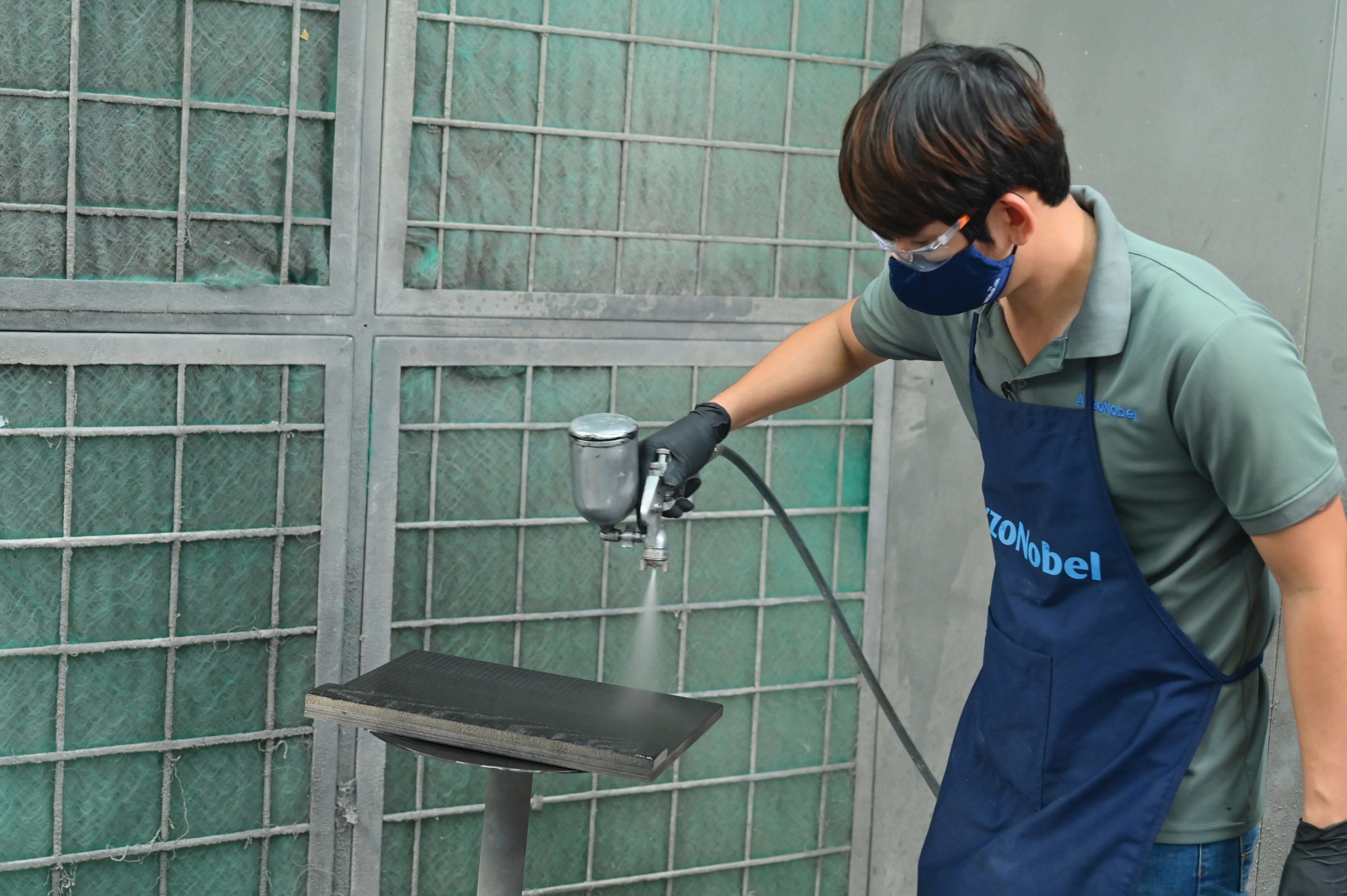
Similarly, the local businesses of Vietnam are capable of competently creating furniture surfaces. For instance, upon an order, they will go to AkzoNobel’s Lab to learn and work towards coating solutions, such as the textures, colours, the desired effects, etc. When the optimal solutions are reached, our experts at AkzoNobel will convene training sessions at the business’ premise, coaching on the fabrication process. Once the training is over, the products coming out of their factory will attain an overwhelming surface solution. Meaning that, once equipped with good designs and creative solutions, furniture companies in Vietnam are entirely able to deliver products capable winning the hearts of global consumers.
Design as the foundation
Founded in 1792, AkzoNobel is proudly the world leader in the craft of making paints, coatings and unique chemical substances. Headquartered in Amsterdam, Netherlands, we are currently employing 45,000 people across 80 countries. Though appearing more lately, after other paint segments of our company, our wood coatings are invested with a great amount of creativity, so that we can closely work with the customers and develop new surface solutions to the wood industry. In the Asia – Pacific region particularly, this creative force of ours consists of nearly 1000.
From kitchen cabinets to wood floors, from windows to doors, bed cabinets to in-exteriors, our experts are always ready to offer relevant and efficient solutions for businesses. By our investment in creativity, AkzoNobel has attained an operation model flexibly designed to cater for each individual customers’ demands. As a global company, our wood coatings sector is operational across the U.S, Europe and Asia, ready to provide comprehensive on-site technical support.
AkzoNobel has an outstanding advantage market-wise, in particular our organic, close relationships with our customers in the U.S. We are regularly updated on the latest trends, market insights, the demands and inquiries directly from the distributors as well as the builders, in order to offer predictions and share them with the manufacturers, helping them to be ready against the market changes.
Brand as the foundation
The new technologies like 100% UV cured, water-based coatings and low VOC (volatile organic compounds) are an important component of AkzoNobel’s sustainable solutions. We take it upon ourselves to work in favour of the future generation, therefore our green development strategy is closely connected with 3Ps: People – Planet and Paint. From our own experiences, we have seen that setting goals towards sustainable growth will bring about competitive edges for the businesses. Currently, manufacturing furniture calls for an ecosystem of a host of suppliers and partners, from the raw materials to components, equipment, etc.
By using coating products that fully meet the standards of sustainable growth such as our products, the businesses are indirectly affirming their green commitment and more easily importing to the strictest markets such as the U.S, Europe, Japan or South Korea. Such partners can always leverage upon our sustainable commitments and certificates to convince for more orders.
Resuming the supply chain model above, 50% of the product’s value belongs to branding. Not many Vietnamese businesses step out to the global markets on their own reputation and corporate stories. To build the brand takes time and a great deal of passion, as well as an appropriate strategy. In this context, collaborating with international brands and leveraging their resources is the shortest and most efficient way to bolster the company’s position, to easily win the customers’ trust. The nature of collaboration will result in greater resonances, and thus, greater efficiencies to all involved.
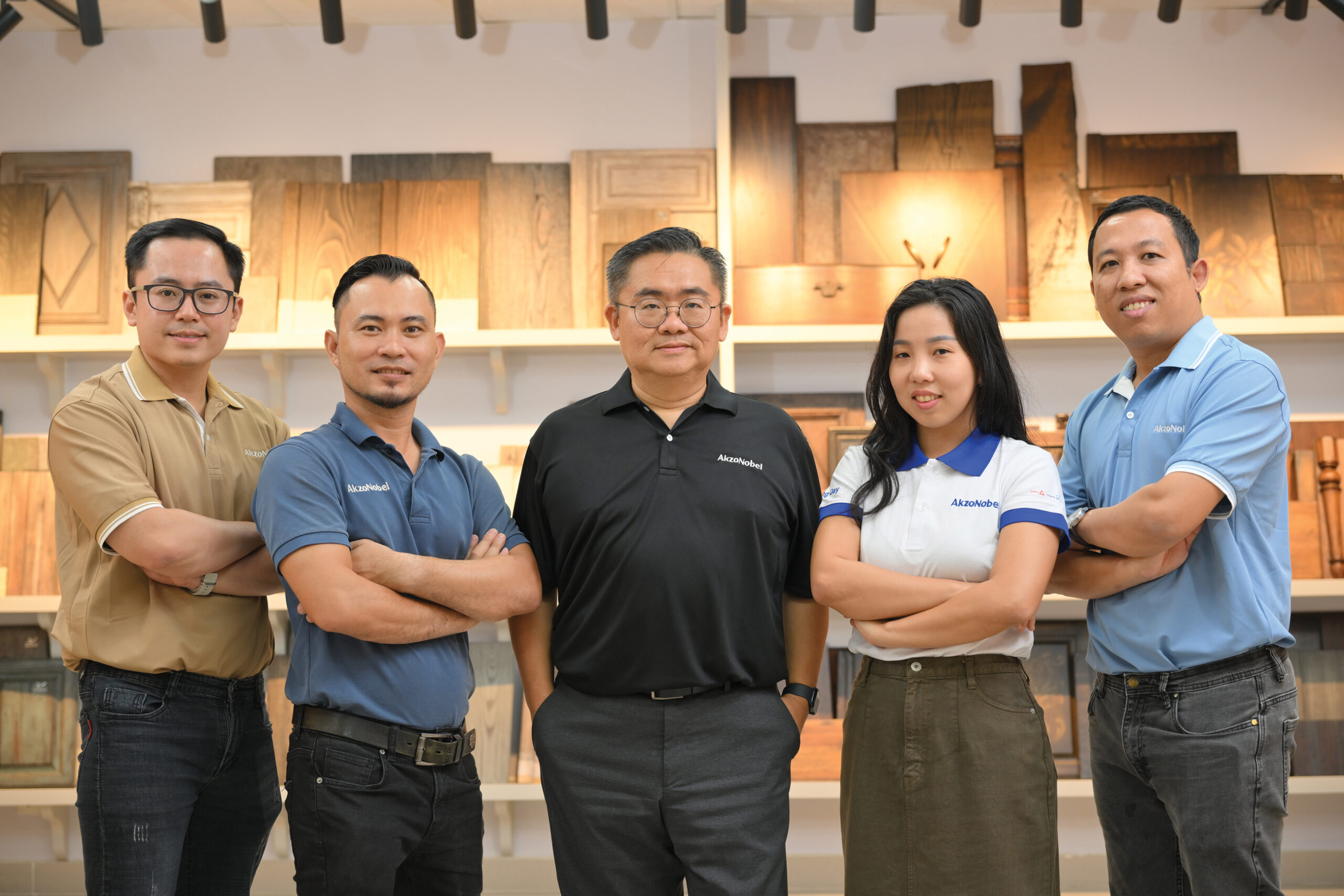
Tee Loi Gan – Asia Regional Technical Service Manager,
Wood Finishes, AkzoNobel
Recorded and written by L.K